
What’s on your plate today?
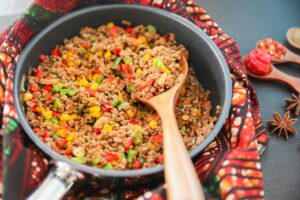
Blending mathematics and the art of cooking! Let’s plate this idea with a sprinkle of creativity
Culinary Calculations
Dive into the kitchen to explore math through recipes, proportions, and
ingredient measurements. Use examples like scaling recipes to serve more or
fewer people or calculating the total weight of ingredients. Explore the math of food
miles by tracking how far ingredients travel to reach your plate.
Engaging Activity: Students calculate the percentage of local vs. imported ingredients in a meal. Add sustainability insights by comparing carbon footprints!
On today’s mathematical menu
Global Fusion Stir-Fry.
 It starts with exactly 300 grams of Basmati rice, shipped in from the Punjab region of India—traveling roughly 6,500 kilometers to land on your pantry shelf. To this, we add 250 milliliters of coconut milk from the lush coasts of Sri Lanka, a mere 3,200 kilometers away.
Next, we toss in a colorful medley of vegetables: 200 grams of locally grown carrots from just 10 kilometers away and 150 grams of bell peppers imported from Spain, which have embarked on a 6,800-kilometer journey. Finally, a dash of Zanzibari spices—cloves and cardamom harvested just 100 kilometers from your kitchen—ties it all together.
Now let’s sharpen our mathematical appetite. What’s the total weight of the ingredients? What fraction of the dish's weight traveled over 5,000 kilometers to reach you? How does the food’s carbon footprint change if you sourced everything within a 50-kilometer radius?
This recipe doesn't just taste good—it offers a feast of real-world math concepts like distance, weights, proportions, and even sustainability metrics.
It’s like teaching global awareness, one spoonful at a time. What do you think?
Shall we garnish it with more calculations?